What Is In The Jar
Ceylon or Cassia: How to Tell Which Cinnamon Is in Your Jar
By the Metabolic Reset editorial desk · Reviewed September 2026 · 10 min read
There are two very different barks being sold under one word, and the label almost never tells you which one you bought.
If you have been adding cinnamon to your morning because you read something about blood sugar, this is the article that decides whether any of that was ever going to do anything.
Two barks, one word
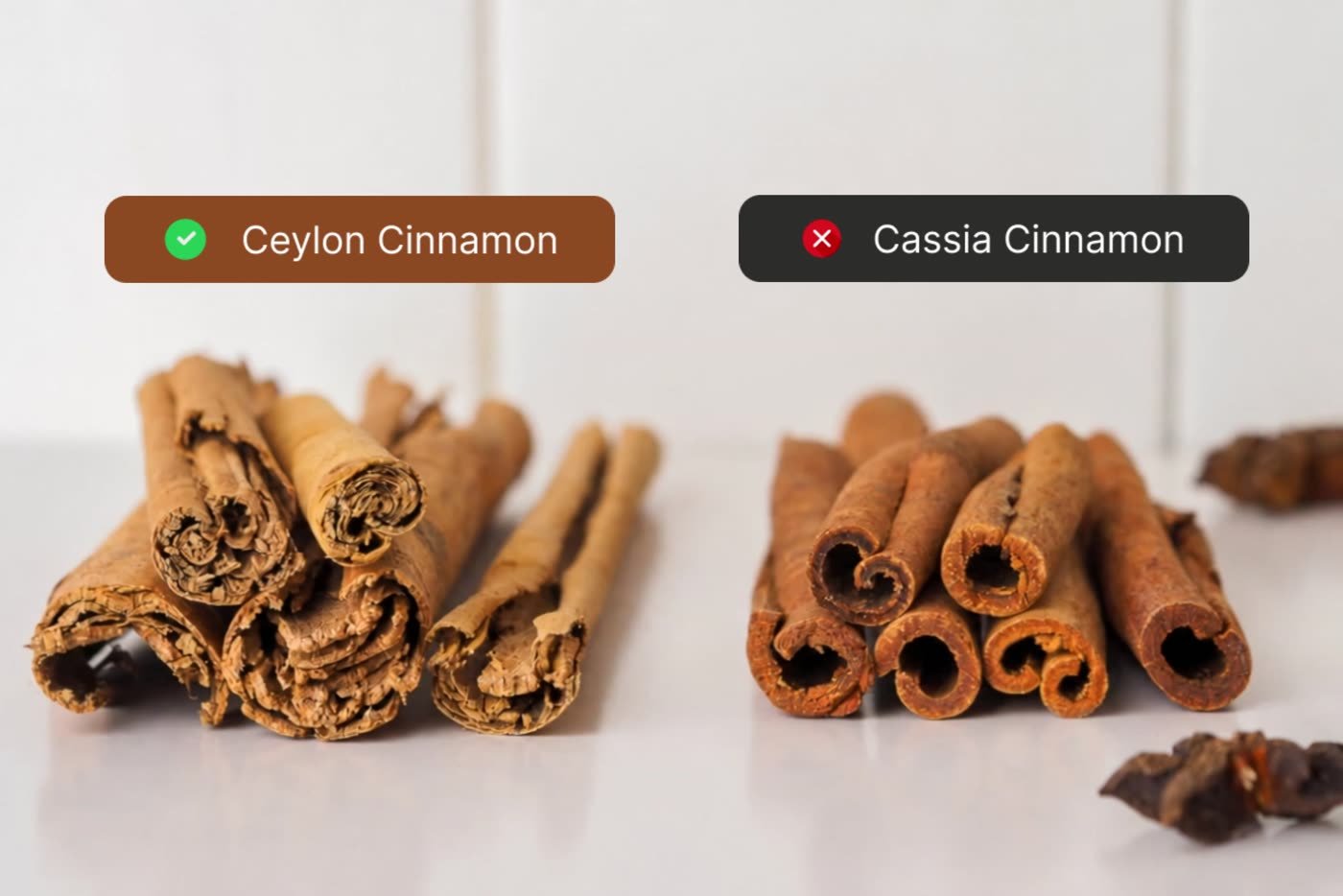
True cinnamon — Cinnamomum verum, sold as Ceylon — comes from Sri Lanka. It is thin, pale, expensive, and it is the one that appears in most of the research people are actually citing.
Cassia comes mostly from Indonesia, Vietnam and China. It is thick, dark red-brown, and it is cheap. In the United States, cassia is what "cinnamon" means on a supermarket shelf the overwhelming majority of the time, because federal labelling does not require the distinction.

How to tell, in about five seconds
- The stick. Ceylon rolls up in many thin, soft layers, like a cigar. Cassia is one thick hard curl, closer to a hollow tube.
- The colour. Ceylon is tan and light. Cassia is dark red-brown.
- The texture. Ceylon crumbles between your fingers. Cassia does not.
- The price. This is the honest one. Ceylon costs several times more. If it was cheap, it was cassia.
Ground into powder, none of those tests survive. Which is why the jar in most American kitchens is an unknown.
Why the distinction is not only about strength
Cassia contains coumarin, a naturally occurring compound. Ceylon contains it only in trace amounts.
European food safety bodies set a tolerable daily intake for coumarin, and analyses of retail cassia have repeatedly found that a couple of teaspoons a day can put an average adult at or over that figure. It is not a reason for alarm about a cinnamon roll at Christmas. It is a real reason to think twice about a daily spoonful taken deliberately, every morning, for a year.
The uncomfortable version: the person most likely to be taking cinnamon daily on purpose is the person who read that it supports healthy blood sugar. That is also the person most likely to be taking the cheap bark, in the largest amount, for the longest time.
Then there is the second problem, which is dose
Set the coumarin question aside for a moment and there is still a gap between a kitchen spoonful and the amounts used in the studies people are quoting.
The research that gets summarised into headlines generally uses concentrated extract, standardised, taken consistently. A spoonful of ground bark stirred into oatmeal is not a small version of that. It is a different thing wearing the same name.
And cinnamon's useful compounds are largely fat-soluble, which means how they are carried matters as much as how much there is. Dry powder in water is close to the worst delivery available.
How much of this describes your morning?
Check what is true.
- You add cinnamon most days because of something you read about blood sugar
- The jar came from a supermarket and does not say Ceylon anywhere
- You have been doing it for months and could not name one thing that changed
- Your number at the last appointment was described as borderline, or "watch it"
- Afternoons are heavy, and something sweet at three has become routine
- You would rather do something daily and simple than add another prescription
Three or more and the honest summary is this: you are running the right idea with the wrong bark, at a fraction of the dose, in the form that carries it worst.
What a corrected version looks like
Get all three right at once and the description gets specific quickly:
- The right bark. Cinnamomum verum — true Ceylon — not cassia, which means trace coumarin instead of a daily accumulating load.
- A standardised extract. Concentrated to the range used in research, not a kitchen spoonful whose strength varies jar to jar.
- Carried in fat. Paired with MCT so the fat-soluble compounds are actually absorbed rather than mostly passed through.
Each of those three on its own is a small improvement. Together they are the difference between a habit and a routine that does something.
The product built around exactly those three
CinnaShield is a Ceylon cinnamon extract paired with MCT, made specifically around the three failures above: the wrong species, the wrong concentration, the wrong delivery.
It is a supplement designed to support healthy blood sugar already in the normal range. It is not medicine, it does not replace anything your doctor has you on, and nobody should stop a prescription over an article.
GET THE CEYLON VERSION →True Cinnamomum verum, standardised, carried in MCTShips from within the United States. Full refund if nothing changes.
What people describe
"I had been putting supermarket cinnamon on everything for two years. I switched because of the coumarin, honestly, not because I expected anything. The thing I noticed within a few weeks was the afternoon — I stopped needing something at three."
Frank D., 61 — on his seventh week
"My husband and I both take it. He is the one who was told to watch his numbers; I just wanted the steadier afternoons. We are both still doing everything our doctor asked. This sits alongside it."
Carol A., 58 — on her fifth month
Individual results vary, and neither of those two changed anything their doctor had them on. That is the correct way to use something like this.
Why nobody tells you which one you bought
There is no conspiracy here, only economics and a labelling gap. United States food labelling does not require the species to be declared, and cassia costs a fraction of what Ceylon costs.
Put those two facts together and the shelf fills with the cheap bark under the general word, which is exactly what happened.
The result is that a person can run the routine correctly, daily, for a year, with the wrong raw material, and reasonably conclude the whole idea was a myth.
The three failures stack
It is worth being precise about why the kitchen version so rarely does anything, because it is not one problem.
Wrong species means the compound profile is not the one in the research and there is a coumarin load riding along with it. Wrong concentration means even the right species arrives at a small fraction of the studied amount. Wrong delivery means the fat-soluble part of what did arrive largely does not get absorbed.
Fix one and you have changed very little. The reason CinnaShield exists is that all three had to be fixed at once for any of it to be worth doing.
"I am a retired pharmacist, so the coumarin was the part that got my attention, not the blood sugar. Once I looked into the species question I was slightly embarrassed at how long I had been doing it wrong."
Gerald F., 68 — on his third month
Why it is sold in supplies
True Ceylon is a limited crop and standardised extract of it is a limited input, which is why the larger supplies go out of stock periodically.
It is also why the guarantee is attached to the full supply rather than a single bottle: one bottle ends before anyone could reasonably tell whether their afternoons changed.
What the wrong jar has already cost
Not much in money — supermarket cassia is cheap, which is the entire reason it is what is on the shelf.
In time it is a different figure. Someone doing this daily since last spring has run roughly two hundred mornings of a routine that could not have worked, and drawn the reasonable conclusion that cinnamon does nothing.
Why the longer supply
Nothing in this category is a two-week story. The bundles exist because the honest window is months, not weeks, and because a single bottle usually ends right before anybody could tell whether it was working.
Use the full supply. If nothing changed, it costs you nothing.
Finish it and if your mornings, your afternoons and your numbers look exactly as they do today, write in and the full amount goes back. Empty bottles are expected.
What changes, and roughly when
Nothing dramatic in week one. What people describe first is the afternoon: the three o'clock dip getting shallower, the reach for something sweet becoming less automatic. Sleep is often mentioned somewhere after that.
Numbers are the slowest part and they belong to your doctor, not to a supplement page. What is reasonable to expect from a daily routine is steadier days, and the honest window for judging that is months.
Why it does not work for some people
- They judge it in two weeks. This is not a two-week category and never was.
- They take it inconsistently. Daily, with food. Four days a week is a different routine.
- They buy one bottle. It runs out right before there is anything to judge.
The questions that come up most
I take metformin, or insulin, or both.
Talk to your doctor before adding anything, and keep taking exactly what you have been prescribed. Do not change a dose because of an article on the internet — this one included.
Is it a subscription?
No. One supply size, one payment, nothing renews.
Can I just buy Ceylon sticks instead?
You can, and it is a real improvement over cassia. It does not solve the other two problems, which are concentration and how the fat-soluble compounds are carried.
What if nothing changes?
Finish the supply and write in. The full amount goes back and empty bottles are expected.
What happens after you click
The button opens the secure order page for CinnaShield. You choose a supply size, enter your details, and it ships from within the United States, usually arriving inside a few days.
Six months from now
In one version you are still spooning the cheap bark into your oatmeal every morning, and still could not name a thing that changed.
In the other you swapped which bark, which concentration and how it is carried — and the routine finally had a chance to be worth the two hundred mornings.
SWAP THE JAR FOR THE RIGHT ONE →So the next two hundred mornings are worth somethingSources and further reading
Blahova J, Svobodova Z. Assessment of coumarin levels in ground cinnamon available in the Czech retail market. ScientificWorldJournal, 2012. PMID: 22645416
Abraham K, et al. Toxicology and risk assessment of coumarin: focus on human data. Mol Nutr Food Res, 2010. PMID: 20024932
Allen RW, et al. Cinnamon use in type 2 diabetes: an updated systematic review and meta-analysis. Ann Fam Med, 2013. PMID: 24019277
Ranasinghe P, et al. Medicinal properties of true cinnamon (Cinnamomum zeylanicum): a systematic review. BMC Complement Altern Med, 2013. PMID: 24148965