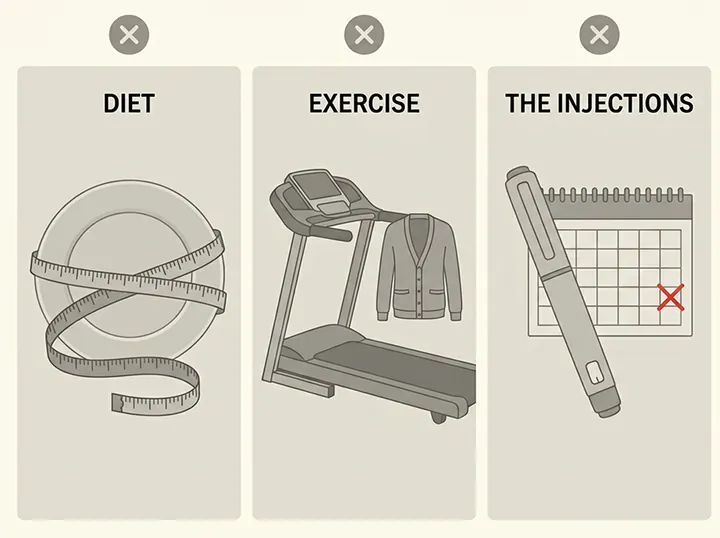
Daily Patterns
Fine at Seven, Undoing the Button by Two
By the Metabolic Reset editorial desk · Reviewed September 2026 · 10 min read
The button is not tight when you put the trousers on. That is the part that makes this complaint so easy to dismiss and so annoying to live with. At seven in the morning everything closes. By two in the afternoon you are sitting differently at your desk, and by four you have quietly undone something.
A waistband that changes across a single day is not measuring how much you weigh. It is measuring what happened between breakfast and lunch.
A day is not one metabolic state
It is tempting to think of the body as having a setting — fast, slow, stuck. It does not. It has a series of decisions, meal by meal, about whether the energy that just arrived gets used now or put away.
Those decisions are governed by hormones that move on a daily clock, and that clock changes with age. The same lunch you ate at 35 arrives into a different set of instructions at 52.
The three o'clock crash is part of the same event
Most women describing the afternoon waistband describe something else in the same breath, usually without connecting the two: they are starving again by mid-afternoon, and tired in a way that coffee does not fix.
Those are not two problems. Hunger returning early and energy dropping hard are both what it looks like when the satiety signal from a meal ends sooner than the meal should have lasted.
The signal has a shelf life, and it is shorter than you think
When you eat, your gut releases GLP-1. It is the hormone that tells your brain the meal happened and that it was enough. It is also the hormone the injectable medications imitate — that is the entire mechanism of that class of drug.
Your body also produces an enzyme called DPP-4 whose job is to take GLP-1 apart. In a healthy young system that is fine housekeeping. The signal is meant to be temporary.
The problem is what happens when the housekeeping gets faster than the signal. The meal is registered, briefly, and then it is not. You are hungry at two in the afternoon after a lunch that should have carried you to six.
Why this shows up as a waistband: a meal that gets stored instead of spent, repeated daily, does not distribute itself evenly. Abdominal storage is the default after estrogen declines, which is why the change is felt at the button and not at the sleeve.
How much of this is your afternoon?
Check the ones that describe an ordinary Tuesday.
- The waistband is fine in the morning and not fine by mid-afternoon
- You are hungry again well before the next meal is due
- Between two and four you would trade almost anything for a nap
- Something sweet at three has become part of the routine
- You eat what you always ate and the trousers disagree
- Mornings are your best hours and it has been that way for years now
If most of those are checked, the thing to look at is not the size of lunch. It is how long lunch is being allowed to count.
The woman who wrote the morning recipe calls this the missing step
Dana Whitfield is a formulator. She is also the person who wrote the original version of the baking soda morning routine that spread online this summer — and she has spent the months since telling anyone who will listen that the version circulating is missing two thirds of itself.
"Everybody kept the baking soda," she said. "It is the visual one. It fizzes. It looks like something is happening. The step that actually deals with the afternoon is the one nobody clipped."
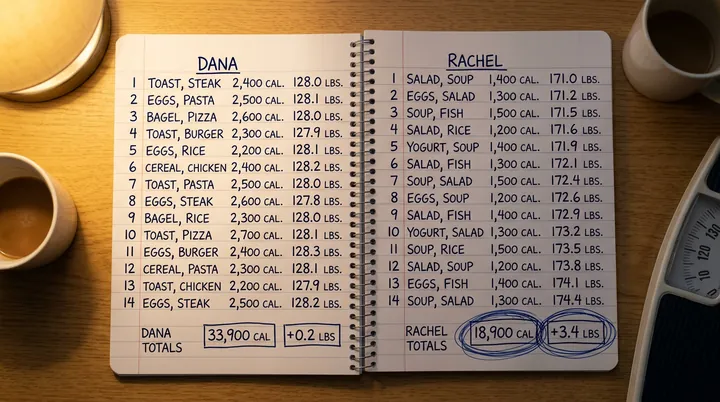
She did not go looking for this. Her sister Rachel, 48, was eating carefully, walking daily, and gaining anyway. Whitfield — her words — was the thin sister who told her to try harder for four years before she sat down and logged both of their meals side by side for two weeks and found the columns nearly identical.
Wake, Protect, Flip
The recipe she landed on has three parts, and she is firm that the order is not decoration.
Wake is the sodium bicarbonate. It addresses the acidic environment that makes cells slow to take up and spend energy. It is the step the internet kept, and on its own she says you will feel essentially nothing.
Protect is concentrated gingerol. It slows DPP-4 — the enzyme dismantling your satiety signal — so the GLP-1 you already make lasts closer to the length of the meal it belongs to. This is the step aimed squarely at two in the afternoon.
Flip is berberine, working on AMPK, the switch between storing and spending.
"If your complaint is the afternoon specifically," she said, "Protect is the one you are missing. And it is the one that is basically impossible to hit from a spice jar."
Why the kitchen version disappoints
She tried it in her own kitchen for eleven months before she gave up on that route.
Ground ginger from a supermarket jar delivers a small fraction of the gingerol required, and most of that does not survive the stomach. Berberine is bitter and absorbs poorly by itself. Baking soda measured by eye is unpleasant in a way you notice immediately.
"One ingredient doing one job at a tenth of the dose is not a recipe," she said. "It is a rumour about a recipe."
The finished version
SlimSoda is the three steps, in proportion, in the order, in one measured scoop stirred into a glass of water in the morning.
ORDER THE FOUR-MONTH SUPPLY →So two in the afternoon stops being the worst hour of your dayShips from within the United States. Refunded in full if nothing changes.
What tends to change first
"The afternoon went first, and it went fast — within about ten days I stopped needing something sweet at three. I did not care about the scale for the first month because for the first time in years I was not exhausted at my own desk."
Karen S., 49 — on her seventh week
"I bought it for the weight, honestly. What I noticed was that I stopped undoing my skirt in the car on the way home. That sounds small. It was not small to me."
Priya N., 54 — on her third month
Results vary from person to person. The order in those two accounts — afternoon first, clothing later — is the one Whitfield says to expect, and the reason she asks people not to judge it in week two.
What she found at one in the morning
The notebook proved the calories were not the variable. It did not explain anything.
The explanation, when she found it, was about incretins — the hormones your gut releases when you eat. GLP-1 tells the brain the meal happened. An enzyme called DPP-4 exists specifically to take GLP-1 apart, and it does so within minutes.
"If that enzyme is working faster than your signal, you are not a person with poor discipline at three in the afternoon," Whitfield said. "You are a person whose lunch stopped counting at one."
The part that is not about a waistband
What Rachel describes now is not the trousers. It is that the second half of her day exists again — that four in the afternoon is a working hour instead of an hour to survive.
"She got her afternoons back before she got her clothes back," Whitfield said, "and if you had asked her at the time which one she wanted first, she would have said the clothes. She was wrong about that."
"Two to four used to be a write-off. I would put anything difficult in the morning because I knew I would not be able to think later. That is genuinely the thing that changed, and it changed inside about three weeks."
Michelle O., 51 — on her fourth month
Why it is sold in supplies, not bottles
Her team wanted single tubs. She refused, on the grounds that a single tub runs out at exactly the point where somebody is deciding whether it is working.
"Fewer customers, given a real chance, over more customers given a fortnight," she said. The bundles cost less per tub and they are the only sizes the full guarantee applies to.
Both the concentrated ginger and the berberine are supply-limited, so bundles do go out of stock from time to time.
What the alternatives cost
The berberine capsule sold as a celebrity shortcut runs around a hundred dollars a month and does one of the three steps. The injectable version of the satiety signal runs closer to a thousand a month, and it is a rental — the signal leaves when the prescription stops.
Why she pushes the larger supply
"Four months, not two weeks. Rachel's afternoons changed early and her clothes changed late, and if I sell somebody one tub they quit in the gap between those two things."
Finish the supply. If your afternoons are the same, it is free.
Use the whole thing. If two in the afternoon looks exactly like it looks today, write in and every dollar goes back. Empty tubs are expected.
What two in the afternoon can look like instead
The hour arrives and nothing happens. That is the whole description, and it is strange how much of a day it gives back.
You are not calculating how long until dinner. You are not standing at the cupboard door at ten past three having a small argument with yourself. You get in the car at six and the skirt is doing exactly what it was doing at eight in the morning.
Where people go wrong with it
- Judging it in week two. Afternoons move early for most people and clothing moves late. Deciding at day ten is deciding on the wrong evidence.
- Taking it inconsistently. One scoop, in the morning, daily. Three mornings a week is a different routine than the one anyone tested.
- Buying a fortnight of it. A two-week supply ends precisely when it starts being possible to tell.
Questions people ask before ordering
I am on medication — is this a problem?
Speak to your doctor first, and do not stop anything you have been prescribed. This is meant to sit next to your care, not to replace any part of it.
Does it auto-renew?
No. One supply size, one payment, nothing recurring.
Will it upset my stomach?
The ginger is there partly for that reason. It is taken in a full glass of water in the morning, which is also why the dose and the form matter more than people expect.
What if my afternoons do not change?
Then you finish the supply and write in, and the money goes back. That is the entire point of asking you to use all of it.
What happens when you click
You land on the secure order page for SlimSoda. Choose your supply size, enter your details, and it ships from within the United States. Most orders arrive inside a few days, and you begin the morning after that.
Two versions of March
In one of them, three in the afternoon is still the worst hour of your day and you are still doing the thing in the car.
In the other one, you stopped noticing the button somewhere around week six and could not tell anyone the exact day it happened.
GET THE STEP THE VIRAL VERSION LEFT OUT →The one aimed at your afternoons specificallySources and further reading
Nauck MA, Meier JJ. Incretin hormones: their role in health and disease. Diabetes Obes Metab, 2018. PMID: 29364588
Deacon CF. Physiology and Pharmacology of DPP-4 in Glucose Homeostasis. Frontiers in Endocrinology, 2019. PMID: 30984107
Bischoff-Ferrari HA, et al. Skeletal muscle mass and aging. Osteoporos Int, 2015. PMID: 26138582
Zhang Y, et al. Berberine and AMP-activated protein kinase activation. Metabolism, 2010. PMID: 19800084